01
Claims without evidence
When a box comes back damaged, the claims desk has to show which leg it happened on. Paper receipts and loose photos rarely say.
For shipping lines and shipowners
Your containers pass through terminals, railways, hauliers and depots you don't run. Plomba gives each of them the same inspection, coded to the standards your systems read and sealed so it holds up in a claim.
What gets in the way
01
When a box comes back damaged, the claims desk has to show which leg it happened on. Paper receipts and loose photos rarely say.
02
Each terminal and depot reports condition its own way: free text, faces missing, photos without a date or a place.
03
A CODECO tells you a container passed the gate. It rarely tells you what the container looked like, or where the photos are.
What Plomba gives you
For new damage, a Muse Spark agent drafts a claim against the party that had custody. Every item and hash it cites is checked against the sealed records before the draft is shown.
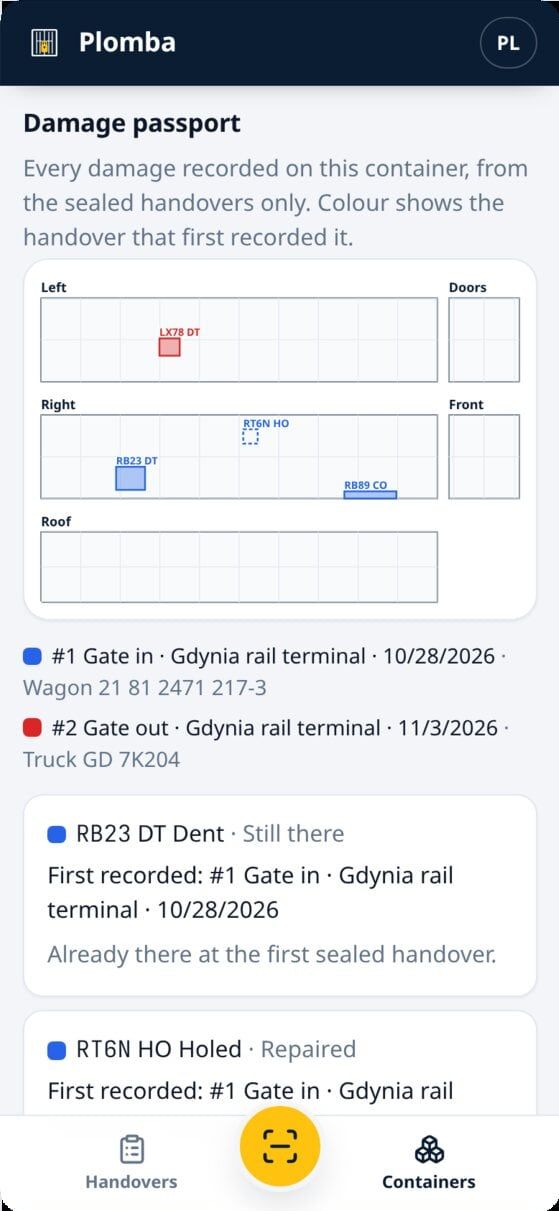
The damage passport places each damage between the last handover that photographed the spot clean and the first that recorded it, so a dispute narrows to the legs in between.
Gate-in and gate-out messages in EDIFACT CODECO D.95B, with ISO 9897 damage codes and the sealed record's SHA-256.
The record follows the container number, not the site, so the next handover anywhere starts from the last one.
How it fits in
Plomba sends what your claims and equipment systems need as each handover is sealed.
Receive the handover.sealed webhook: it carries the marks and, for each damage, the last handover that photographed the spot clean.
Take CODECO gate messages into your EDI flow next to the ones you already receive.
For a handover with new damage, ask for a claim draft over the same API.
examples/shipping-line-claims-desk
A claims desk that checks each signed delivery and opens a claim for damage that appeared on a leg, addressed to whoever had the container.
Condition at both ends of the rail leg, with the wagon each container rode on, checked fast when a train arrives.
A receipt the driver can show at the next gate, with the photos and the damage recorded at pickup.
On-hire and off-hire compared on the same spots, with standard codes and evidence for recharging lessees.
The same walk-around for every checker, standard codes without a codebook, and a CODECO for every sealed handover.
Join the Plomba Cloud waitlist, self-host it today, or write to us for an access code to the live demo.