01
Gate throughput
Every minute spent writing up a container is a minute a truck or a train waits.
For terminals and depots
Plomba gives every checker the same walk-around and standard codes without a codebook, and gives your customers a sealed record they can rely on.
What gets in the way
01
Every minute spent writing up a container is a minute a truck or a train waits.
02
CEDEX location, damage and component codes are hard to remember and easy to get wrong.
03
A face gets skipped and nobody notices until there is a claim.
What Plomba gives you
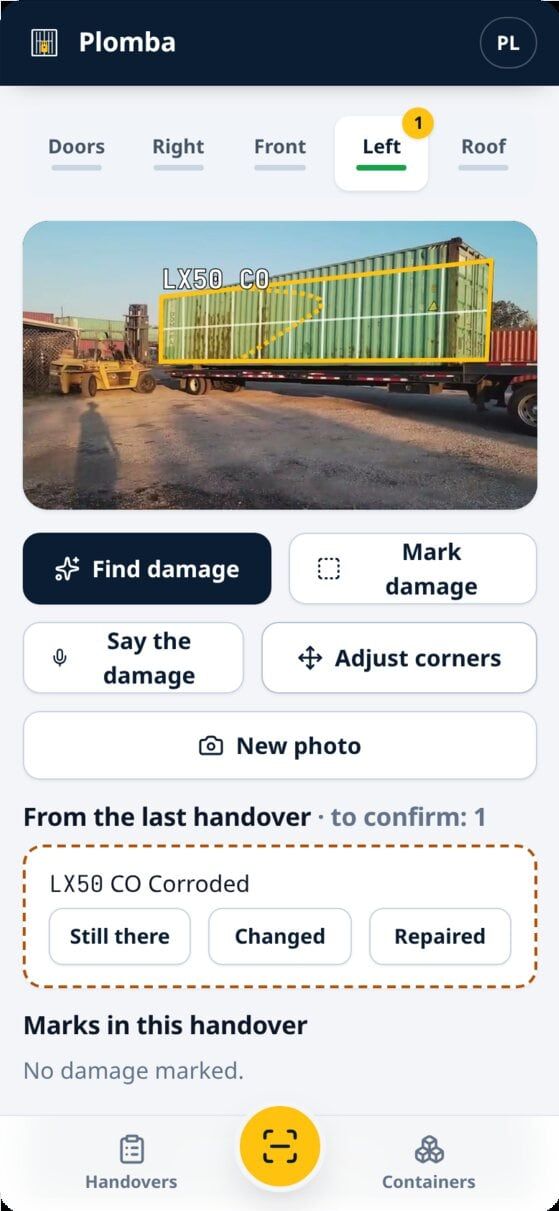
The location code comes from where the mark sits on the container. Muse Spark proposes damage and component codes, and the checker confirms them.
Each face and section lights up once a photo covers it. The checker sees what's missing before sealing, and any gap is recorded.
A gate-in or gate-out message in EDIFACT CODECO D.95B, in the SMDG profile, for every sealed handover.
One Docker container with your data in one directory. Reading and damage detection can run on open weights on your own hardware.
How it fits in
Plomba fits next to your terminal operating system rather than replacing it.
Send CODECO gate messages to shipping lines and operators from every sealed handover.
Receive handover.sealed webhooks in your TOS or yard system, and fetch records over the REST API.
Hand drivers and customers the EIR as a PDF.
Damage claims backed by a sealed record from every handover, and CODECO gate messages that point to the evidence.
Condition at both ends of the rail leg, with the wagon each container rode on, checked fast when a train arrives.
A receipt the driver can show at the next gate, with the photos and the damage recorded at pickup.
On-hire and off-hire compared on the same spots, with standard codes and evidence for recharging lessees.
Join the Plomba Cloud waitlist, self-host it today, or write to us for an access code to the live demo.